Friday, May 17, 2013

Tom Builder and Medieval Gothic Arches


I forgot that I wrote this. It's still funny, at least to me.

Thanks for digging it up Catherine

 http://catherinetoddarchitecture.blogspot.com/


Tom Builder and Medieval Gothic Arches


September 1183 Medieval Builders Scroll’s A Monthly Journal

This work contains the science and practice of constructing Gothic Arches in a simple and familiar manner for the advantages of readers not yet acquainted with geometry, trigonometry or reading, no trigonometry has been employed for it was not necessary. And further, there is always danger of overstocking the average pilgrim’s storehouse of knowledge, the result of which tends to confuse and produce errors.

September 1883 Carpentry and Building A Monthly Journal

This work contains the science and practice of constructing Gothic Arches in a simple and familiar manner for the advantages of readers not yet acquainted with geometry or trigonometry, no trigonometry has been employed for it was not necessary. And further, there is always danger of overstocking the average chipper’s storehouse of knowledge, the result of which tends to confuse and produce errors.

September 2010 JLC A Monthly Journal

This work contains the science and practice of constructing Gothic Arches in a simple and familiar manner for the advantages of readers not yet acquainted with geometry or trigonometry, no trigonometry has been employed for it was not necessary. And further, there is always danger of overstocking the average duster’s storehouse of knowledge, the result of which tends to confuse and produce errors.


Medieval Builders Scrolls September 1183

It was a bitter cold morning in September 1183 and Tom Builder had arisen before the sun lite could flood though the stone clad windows with warm air. With a lite frost on the stone window sills, Tom’s hands could barely grasp the cold steel compass and square. But he knew that his geometric drawing of the ribbed tunnel ceiling for the Cathedral would impress the prior of Kingsbury. The mason’s square and compass were tools used to build strong foundations from geometrically precise cut stones and with Tom’s knowledge of the sacred proportions, masonry and the geometrical drawings that he had seen on the stone tablets at the School of Athens by Euclid, the prior of Kingsbury would see that he was God’s choice for the Master Builder of the Kingsbury Cathedral.

Tom Builder didn’t know what a dodecahedron was, the solid of twelve pentagons, had to do with being a master builder or how to square your square with the 47th Problem of Euclid, but after being named the Master Builder of the Kingsbury Cathedral Tom hired Butch Carpenter who had long since moved on to purlin roofs which allowed ornamental arcading, appropriate to the high decorated and perpendicular styles, to be carried on to the plane of the roof itself and sometimes right up to the apex. Butch’s geometrically precise layout of the Gothic cross vault ribs with ordinates would allow fellow pilgrims to build the elliptical timber false work for the stone cross vaults of any Cathedral.

We submit this method, clearly shown in the diagram, to the readers of Medieval Builders Scrolls for criticism, and shall be pleased to have our fellow pilgrim’s, quarrymen, stonemasons, blacksmiths, mason layers, woodcutters, carpenters, tillers, carters, basket and rope makers that can read, discuss the attach diagram.


Thursday, May 16, 2013

Jack Rafter Claw Model

This model is an unequal pitched roof, with a 9/12 & 12/12 pitch. This model is a study of the easiest way to draw out the jack rafter claws. The geometry for this model uses the prism plane to develop the jack rafter claw angles. The geometry for the jack rafter claws can be developed using the folding roof surface or the draw down roof surface techniques, but using the prism plane seems to be easier and more accurate than the folding roof surface or the draw down roof surface method.

I really like the 3x4 Chappell gauging square for transferring the layout points from the drawing board to the edge of the rafter material. It’s just the right size.


Saturday, May 11, 2013

Hawkindale Angles and the Prism Plane

While studying Tangent Hand Railing system the first thing that you need to study is prisms. After drawing out the following prism for the Hawkindale angles, S, D, R1, R2, R3, R4, R5, P1, P2, P3, P5,P6,A9 and A7, I would now say that the first thing that you need to do while studying compound joinery for timber framing is learn how to draw out the prism for the roof slope and deck angle that you're working with.


Prism Plane = Unbacked shoulder of Hip Rafter & Valley Rafter
Prism Plane = Hip Rafter & Valley Rafter diamond post

Vertical Rotation Plane  = arctan(tan Vertical Plane x cos Horizontal Plane)
Horizontal Rotation Plane  = arctan(cos Vertical Plane ÷ tan Horizontal Plane )

Hinge Rotation Plane  = arctan( tan Horizontal Plane  ÷   cos Vertical Plane)


R1 = Vertical Plane of adjoining roof planes.
Hawkindale R1 = Arctan [Tan S x Sin D]
R1 = arctan(tan SS x cos D)
R1 = arctan(tan S x cos DD)
R1 Plumb Plane = S Plumb Plane rotated by the adjacent plan angle

R2 = Purlin Housing Angle.
Hawkindale R2 = Arctan [Sin S x Cos S x Cos D / Tan D]
R2 =  90° - arctan(sin(plan angle) x tan(purlin rotation angle - roof slope angle) + hip slope angle
Purlin Rotation Angle = 90°
R2 =  90° - (arctan(sin(DD) x tan(90° - SS) + R1)
R2 =  90° - (arctan(cos(D) x tan(90° - SS) + R1)
R2 =Intersection of R1 Plane and  a Perpendicular Plane to P2 Plane

R3 = Line traced on top or bottom of unbacked hip rafter following the perpendicular plane of the purlin.
Hawkindale R3 = Arctan [Sin S x Cos S x Cos D / Sin R1]
R3 = arctan( tan( Jack Rafter Side Cut Angle ) * cos ( Hip Rafter Backing Angle ))
R3 = arctan( tan( P2 ) * cos (C5))
Intersection of Prism Plane & R2 Plumb Plane

R4 = Angle of intersection of  prism plane and vertical plane.
R4 = arctan (tan P2 ÷ cos C5)
R4 = arctan (tan Jack Rafter Side Cut Angle ÷ cos Hip Rafter Backing Angle)
R4 = arctan ( cos Hip Rafter Slope Angle  ÷  tan Plan Angle)
Intersection of Hip Rafter Vertical Plumb Plane & Horizontal Plan Angle Plane


P1 = Purlin Miter Angle on Edge Perpendicular to Roof Surface
P1   = arctan(sin Vertical Plane ÷ tan Horizontal Plane )
P1 = arctan (sin S ÷ tan D)
P1 = arctan (sin Common Rafter Slope Angle ÷ tan Plan Angle)
Intersection of   Common Rafter Plumb Plane & Horizontal Plane


P2 = Jack Rafter Side Cut Bevel Angle
P2   = arctan(cos Vertical Plane ÷ tan Horizontal Plane )
P2 = arctan (cos S ÷ tan D)
P2 = arctan (cos Common Rafter Slope Angle ÷ tan Plan Angle)
Intersection of  Horizontal Plan Angle Plane & Common Rafter Plumb Plane

P2 - 90 = Roof Sheathing Angle
Hinge Rotation Plane  = arctan( tan Horizontal Plane ÷   cos Vertical Plane)
P2 - 90  = arctan( tan Horizontal Plane ÷   cos Vertical Plane)
P2 - 90  = arctan( tan Plan Angle  ÷   cos Common Rafter Slope Angle)
Intersection of  Horizontal Plan Angle Plane & Common Rafter Plumb Plane


Steps To Draw the Roof Framing Prism Plane


Tuesday, May 7, 2013

Sloping Ridge On Pentagonal Ground Plan


Looking at plate # 11 in "Traité Théorique et Pratique de Charpente" by  Louis Mazerolle I revised his geometry technique to easily establish the angle of the sloping ridge and the edge bevel on the sloping ridge.

The key to establishing the sloping ridge angle is to use the profile rafter slope angle and extend the profile rafter slope angle to locate point S, that is perpendicular to point S on the ground plan view.  Then you can easily develop the sloping ridge angle and the edge bevel on the sloping ridge. As in Fig. 3. It is not necessary to extend the sloping ridge out as in Fig. 4 to find the edge bevel of the sloping ridge.


Sunday, May 5, 2013

Octagon Roof Framing Using Traditional Layout Geometry

This Octagon Roof Framing  drawing was developed using Traditional Layout geometry. It gets pretty messy with all the construction lines.

The octagon ground plan has:

  1. R1 -- Jack Rafter plumb to earth, perpendicular to plate line with double miter angles at the peak of the jack rafter and sloping tail return angle. (90°)
  2. R2 -- Jack Rafter plumb to earth, perpendicular to plate line with single miter at the peak of the jack rafter and the claw seat at the hip rafter and  sloping tail return angle. 
  3. R3 -- Octagon Hip Rafter with  sloping tail return angles.
  4. R4 -- Purlin rafter with claw tips, purlin lip cut angles.
  5. R5 --  Jack Rafter plumb to earth, offset/skewed from plate line with single miter angle at the peak of the jack rafter and sloping tail return angle.


In this image of the drawing I turned off the construction lines and dimensions layers.


As you can see it gets pretty messy with all of the construction lines.


Here we have  witches cut on the hip rafter. I've label the lines in the order that they should be drawn. Point # 3 is the critical area. If this is not drawn correctly the  bevel angles on top of the hip rafter tail will not be correct.


The claw on the jack rafter seat at the hip rafter is developed from the H1 & H2 dimension that were first developed from the hip rafter plumb line. 


The claws on the purlin are developed from the plan view of the purlin developed from the purlin at the profile rafter.


The Jack Rafter plumb to earth and  offset/skewed from plate line was developed using dimensions from the plan view.


Friday, May 3, 2013

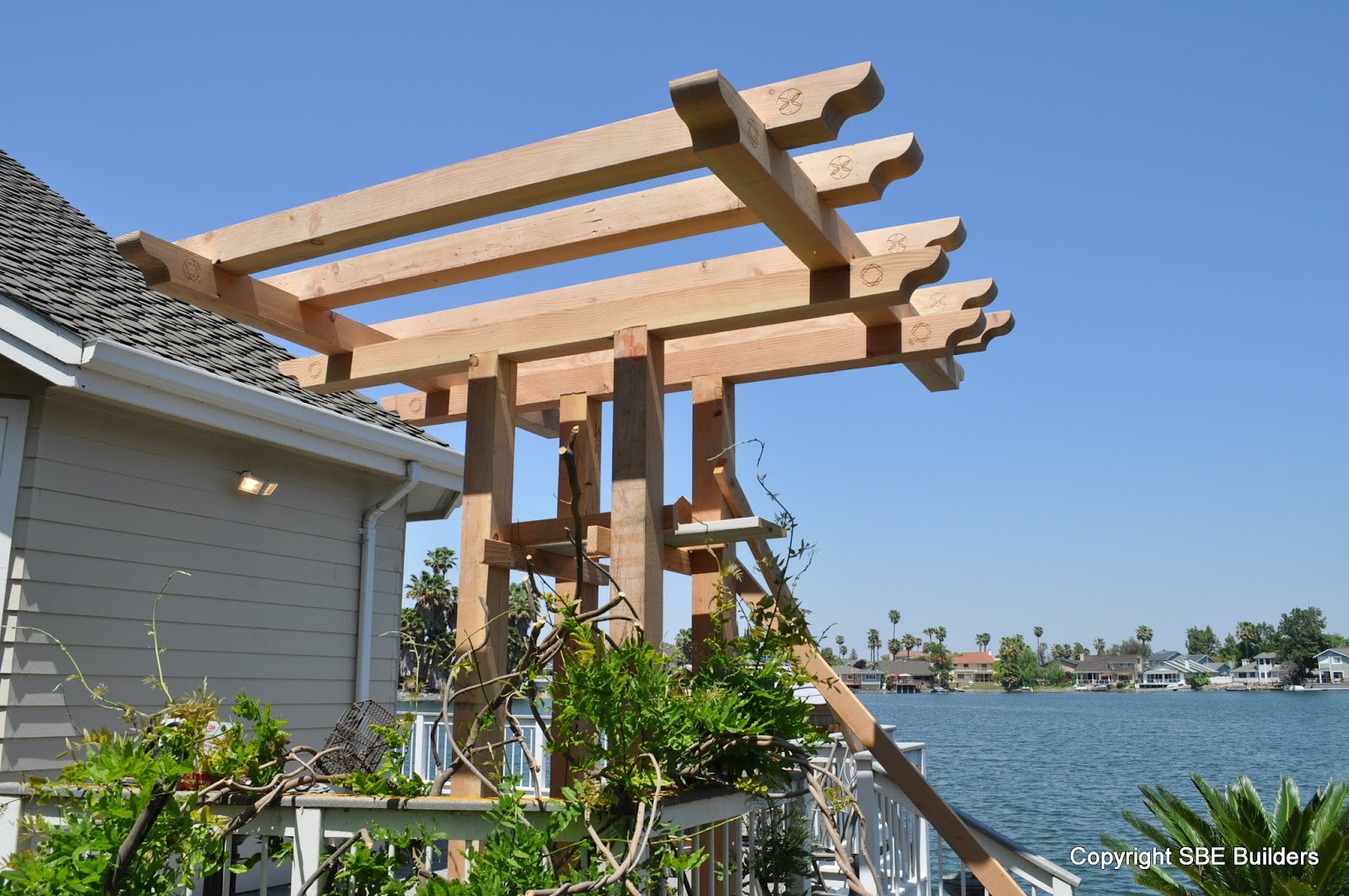
Ad Quadratum - Ad Triangulum - Seed of Life - Daisy Wheel Trellis

I had some 6x6 post left over from a shoring job and used them for my trellis.To replace the tree that had blown over.  Added the geometric symbols Ad Quadratum -  Ad Triangulum - Seed of Life (Daisy Wheel) to the 6x6 post on the trellis to give it some character. It's not the best material for an trellis, but it was free.